
Dr. Pawan Kumar Jewaria
Scientist III
Postdoctoral Fellow: Technical University of Munich, Germany
- 91-11-26735114; Ext:114
- pawanjewaria@nipgr.ac.in; jewariapawan@gmail.com
Profile
Research Interests
Molecular Mechanism of Apical Hook Development
The apical hook develops immediately after seed germination and protects the apical meristem. The curvature of apical hook results from asymmetric cell elongation rates at opposite side of the bending hypocotyls. Since apical hook is not required for survival during growth of Arabidopsis seedlings under laboratory conditions, it is an excellent model system to take genetic and cell biological approaches to study mechanisms underlying differential cell elongation.
Plant cell wall is a dynamic and flexible structure play crucial role during plant growth and development. We are interested to find out how cell wall and phytohormones (auxin and Brassinosteroids) regulate apical hook development. We are using molecular biology, cell biology, genetic and biochemistry to solve the biological question. Our recent research paper (Jewaria et al. 2025) convinced that the new regulatory mechanisms discovered are not only relevant to apical hook formation but also for other processes that involves differential growth such as phototropism and gravitropism. We hope that other researchers can use our results to understand how cell wall mechanics and plant hormones can regulate plant architecture.
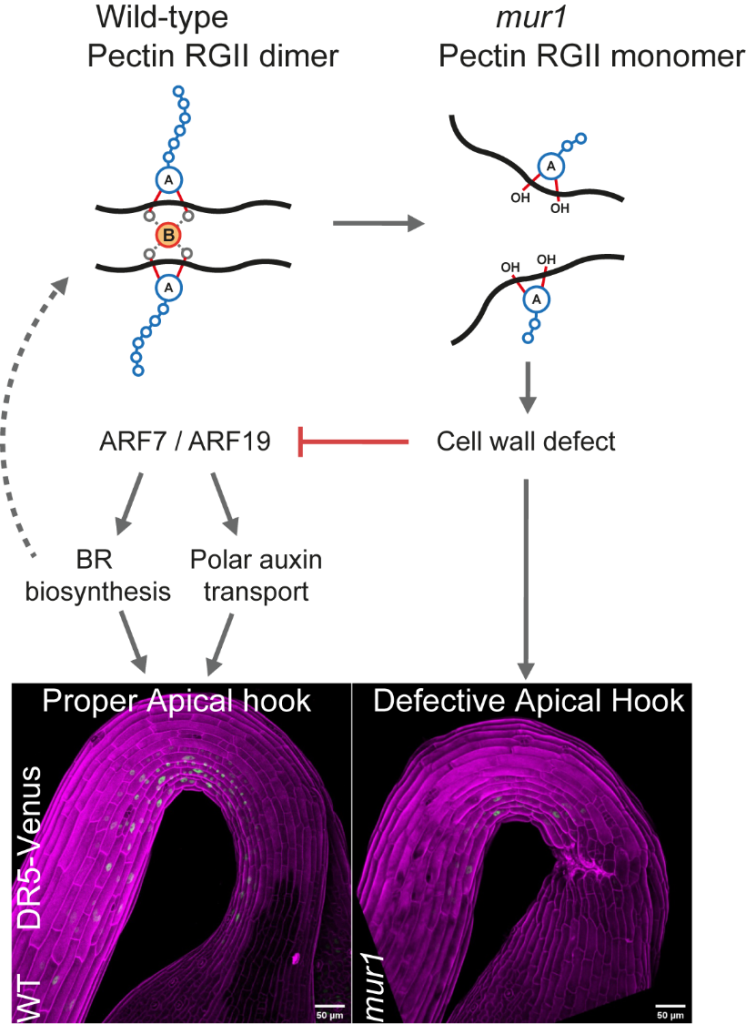
For details please read Science Advances, 11(7), eads0760 (2025)
Plant Development and Immunity Regulation
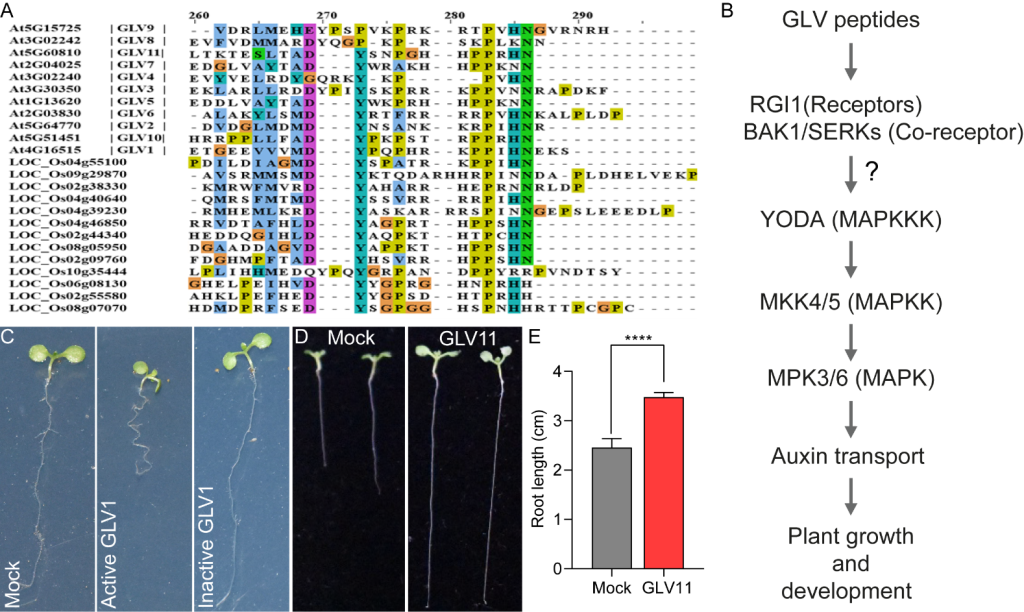
Future sustainable food production demands climate smart agriculture which require deeper understanding of model plant and transfer of knowledge to crop plants. Small secretory peptides are important signalling molecules regulating plant growth, development and immunity. Three independent groups discovered small secretory peptides by using in silico study, named as GOLVEN (GLV)/ Root meristem Growth Factor (RGF)/ CLE-Like (CLEL). The active peptides are 13-18 amino acids in length and eleven members were reported in Arabidopsis thaliana (Arabidopsis). The orthologous genes in rice and other crops are yet to be identified. Sequence homology search suggests that 13 GLV members are present in rice and their function is completely unknown. Our aim is to understand the function and signalling mechanism of GLV secretory peptide hormones in Arabidopsis and rice. We are using state of the art multi-disciplinary approach combining genetics, cell biology, pharmacological, genomics, biochemistry and proteomics. The importance and impact of the project is to develop climate smart transgenic rice plants with better yield by regulating root system architecture
Professional & Academic Background
Staff Scientist III (2022-present): National Institute for Plant Genome Research (NIPGR)
Postdoctoral Fellow (2021-2022): Technical University of Munich, Germany
Postdoctoral Fellow (2019-2021): Umea Plant Science Centre (UPSC), Sweden and Beijing Forestry University, China
Assistant Professor (2016-2018): Jaipur National University, Jaipur, India
Postdoctoral Fellow (2013-2015): University of Tubingen, Germany and University of Bremen, Germany
Postdoctoral Fellow (July 2013-Sept 2013): Osaka University, Japan
Ph.D. (June 2013): Osaka University, Japan
Awards & Honors
Achievers Award from University of Rajasthan, Jaipur, India (2025)
EMBO Workshop "Plant Tropism" Travel award: The workshop held in National Institute for Basic Biology (NIBB), Okazaki, Japan from 09.07.2024 to 12.07.2024
Postdoctoral Grant (Technical University of Munich, Germany) 2021-2022
Postdoctoral Grant (Beijing Forestry University, China) 2019-2021
Postdoctoral Grant (University of Bremen, Germany) 2013-2015
Postdoctoral Grant (Osaka University, Japan) 2013
Japanese Government Monbukagakusho (MEXT) Fellowship for Ph.D. (2008-2011)
Senior Research Fellowship (CSIR, India)-Life Sciences (2006-2008)
Junior Research Fellowship (CSIR, India) -Life Sciences (2004-2006)
Eligibility for Lectureship (Awarded by CSIR, India) -Life Sciences (2003)
Eligibility for Lectureship (Awarded by ASRB, India) - Plant Physiology (2006)
Current Members
Ms. Anshika Singh
JRF
Auxin and Secretory Peptides Regulating Root System Architecture
Ms. Poojha
M. Tech Trainee
Molecular Mechanism of Plant Elicitor Peptide 6 (PEP6) Regulating Plant Growth and Development
Mr. Gokul
M. Tech Trainee
Secretory Peptides Regulating Yield and Yield Stability in Plants
Ms. Saanvi Verma
B.Sc. Trainee
Functional Characterization of GLV2 Regulating Root Gravitropic Response
Harishankar Tiwari
Multitask Person
- harishankartiwari742@gmail.com
Publications
Wang, D., Jewaria, P.K., Xiao, J. (2025). Photosynthetic adaptation in poplar under abiotic and biotic stress: integrating molecular, physiological, and biotechnological perspectives. Int. J. Plant Biol. 16 (42). https:// doi.org/10.3390/ijpb16020042
Du, J., Shao, C., Wang, D., Feng, Z., Cui, C., Li, R., Jewaria, P.K., Wang, X., Xiao, J., Wang, X. (2025). Deletion of the PtrDJ1C gene leads to increased branching in poplar. Plant Physiology and Biochemistry. https://doi.org/10.1016/j.plaphy.2025.109789
Jewaria, P.K., Begum, R.A., Wang, Y., Sancho-Andreas, G., Baba, A.I., Aryal, B., Yu, M., Li, X., Lin, J., Fry, S.C., Verger, S., Russinova, E., Jonsson, K., Bhalerao, R.P. (2025). Reduced RG-II pectin dimerization disrupts differential growth by attenuating hormonal regulation. Science Advances. 11 (eads0760).
Jewaria, P.K., Yu, M., Li, X. (2021). Cell wall and hormonal interplay controls growth asymmetry. Trends in Plant Science. 26 (7), 665-667.
Jewaria, P.K., Hanninen, H., Li, X.., Bhalerao, R.P., Zhang, R. (2021). A hundred years after: endodormancy and the chilling requirement in subtropical trees. New Phytologist. 231, 565-570.
Liu, P.L., Zhang, X., Mao, J.F., Hong, Y.M., Zhang R.G., Yilan, E., Shuai, N., Jia, K., Jiang, C.K., He, J., Shen, W., He, Q., Zheng, W., Abbas, S., Jewaria, P.K., Tian, X., Liu, C., Yin, Y., Liu, B., Jiang, X., Wang, L., Jin, B., Ma, Y., Qiu, Z., Baluska, F., Samaj, J., He, X., Niu, S., Xie, J., Xie, L., Xu, H., Kong, H., Ge, S., Dixon, R.A., Jiao, Y., Lin, J. (2020). The Tetracentron genome provides insight into the early evolution of eudicots and the formation of vessel elements. Genome Biology. 21:291.
Yu, M., Li, R., Cui, Y., Chen, W., Li, B., Zhang, X., Li,X., Bu, Y., Cao,Y., Xing, J., Jewaria, P.K., Li, X., Bhalerao, R. P., Yu, F., Lin, J. (2020). The RALF1-FERONIA interaction modulates endocytosis to mediate control of root growth in Arabidopsis. Development.147 (13)
Kumari, A., Jewaria, P.K., Bergmann, D., Kakimoto, T. (2014). Arabidopsis reduces growth under osmotic stress by decreasing SPEECHLESS protein. Plant & Cell Physiol. 55, 2037-46.
Jewaria, P.K., Hara, T., Tanaka, H., Kondo, T., Betsuyaku, S., Sawa, S., Sakagami, Y., Aimoto, S., Kakimoto, T. (2013). Differential effects of the peptides stomagen, EPF1 and EPF2 on activation of MAP kinase MPK6 and the SPCH protein level. Plant & Cell Physiol. 54, 1253-1262
Opportunities
Highly motivated students and postdocs are encouraged to contact with me (pawanjewaria@nipgr.ac.in) with motivational letter. The applications without motivational letter will not be considered. Foreign national candidates are welcome in my lab. Support and help will be offered to qualified candidates during the application process.