
Salinity-tolerant high-yielding Chickpea variety
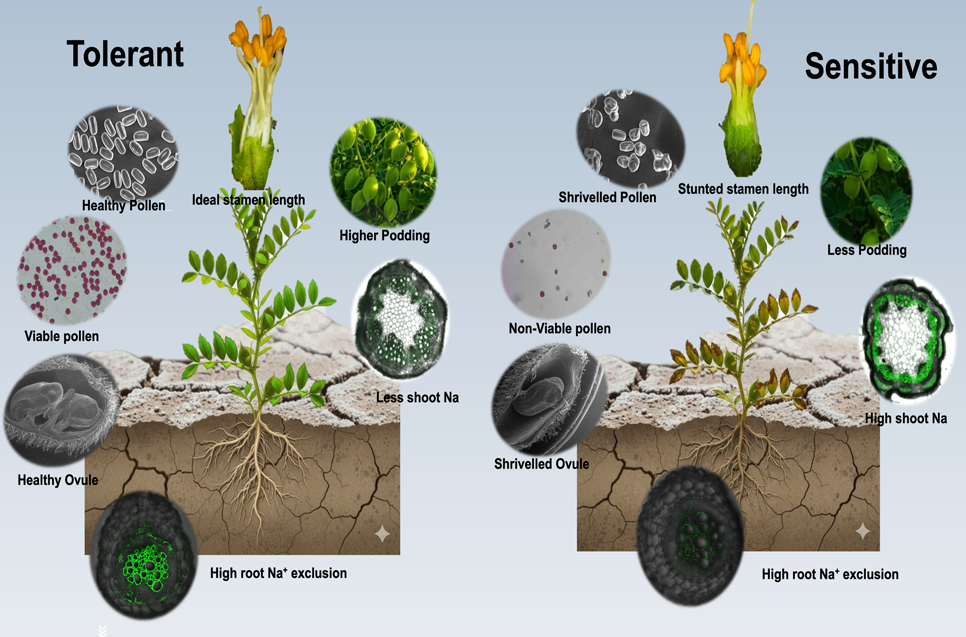
Chickpea is mainly grown in arid and semi-arid regions, making it highly vulnerable to soil salinity. Soil salinity affects nearly 6.7 mha of farmland in India, and even mild salt stress in chickpea causes physiological drought, ion toxicity, and poor nutrient uptake, severely reducing growth and yield.The complexity of salinity stress responses, particularly their tissue- and cell-specific regulation, continues to challenge the translation of molecular insights into tangible crop yield improvements. To address this growing challenge, BRIC-NIPGR deployed a genomics-assisted breeding and functional genomic strategy to delineate a pair of novel CaPHL7 and CaHKT1 alleles that regulate yield under salinity stress.
Using near-isogenic breeding lines, chickpea overexpression lines, and mutant complementation assay, functional significance of these alleles in conferring yield endurance under salinity stress was validated. Functional characterisation of the genes revealed the intricate transcriptional regulation of CaHKT1 by CaPHL7, which influences the degree of salinity stress tolerance. This study provides the first functional validation of a trans-QTL regulatory model in chickpea, where CaPHL7, located on one chromosome, transcriptionally activates CaHKT1 on a separate chromosome. The regulatory mechanism plays a key role in excluding sodium from the transpiration stream, thereby protecting reproductive processes from salinity-induced damage and mitigating yield penalties. This study presents a pioneering example of a trans-QTL interaction in chickpea, where the superior allele in salinity tolerant accessions elevates CaPHL7 expression, which in turn transactivates CaHKT1, thus regulates Na+ exclusion, and ensures reproductive success and yield stability under salt stress. This inter-locus regulation explains yield stability and offers useful insights that may be considered in future efforts to enhance salt resilience in chickpea. The superior allele from a salinity-tolerant landrace introgressed into a mega-variety of chickpea, resulting in a salinity-tolerant, high-yielding variety that is currently undergoing national field trials. This newly developed variety can not only reduce yield loss but also open up the possibility of cultivating chickpeas on salt-affected lands, thereby expanding the area suitable for chickpea production.
Jitendra K. Mohanty, Antima Yadav, Laxmi Narnoliya, Virevol Thakro, Deepanshi Rathore, Shailesh Tripathi, Senjuti Sinharoy, Pinky Agarwal, Swarup K. Parida: Trans-QTL Alliance of HKT1 and PHL7 Modulate Salinity Stress Tolerance and Enhance Crop Yield Endurance, https://doi.org/10.1111/pbi.70373.
